


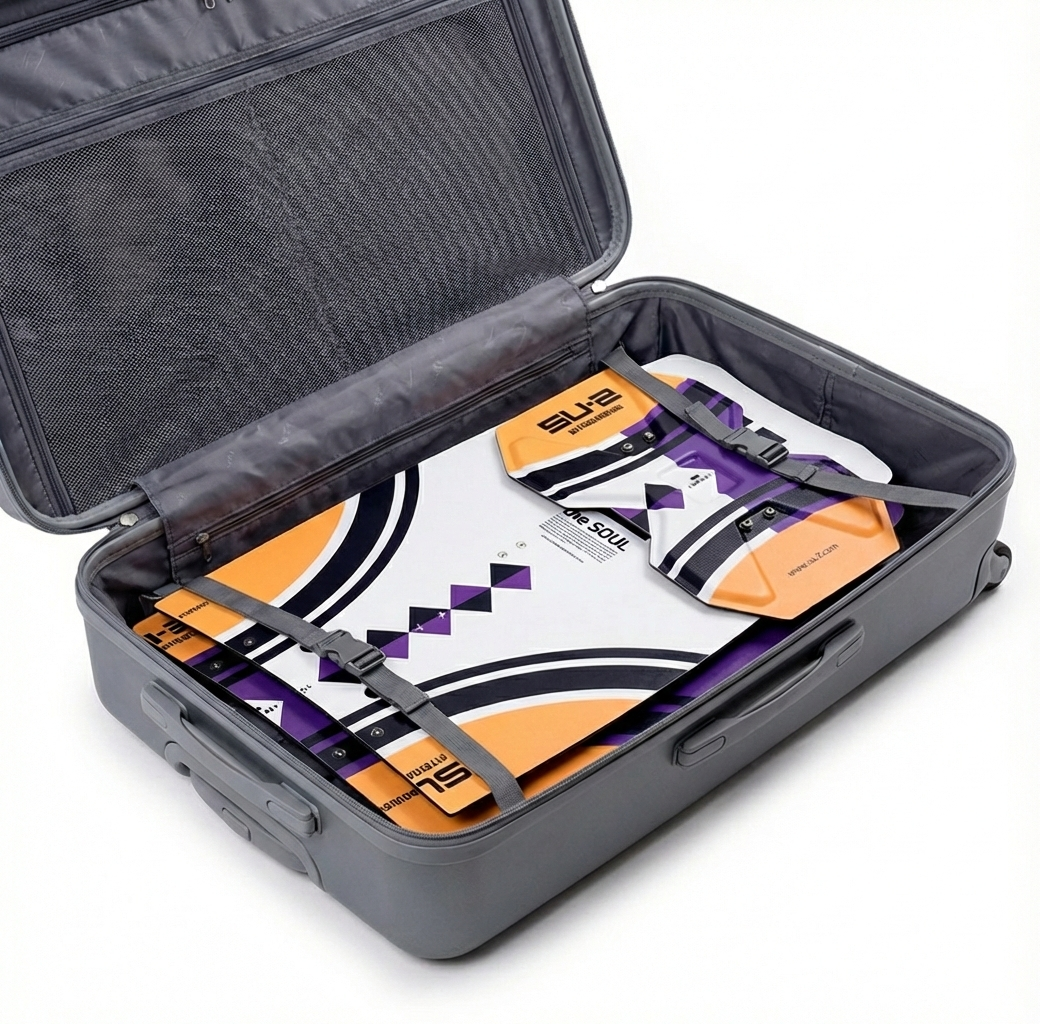
The Cost Breakdown
Airline baggage fees for oversized sporting equipment are neither small nor consistent. Full-service carriers like Lufthansa typically charge $100–150 per segment for a kiteboard. Budget carriers can be cheaper on the surface — Ryanair's standard sports equipment fee runs lower — but strict size enforcement means boards often trigger additional handling charges. On long-haul routes, United and Emirates regularly charge $150–200 per segment. For practical planning, $150 per segment is a reasonable working average across mixed itineraries.
A typical travelling kiteboarder takes three trips per year. That's six flight segments on return journeys. At $150 average, annual baggage costs reach $900. Over five years — a realistic lifespan for a well-maintained kiteboard — that's $4,500 spent purely on getting your board to the water. The board itself may cost $800–1,200. The baggage fees cost four times that over its working life.
A split kiteboard carries a $300–500 premium over a comparable one-piece board from the same manufacturer. That premium reflects the additional engineering complexity: precision-machined joint faces, CNC-produced locking mechanisms, and the structural testing required to validate performance parity. It is not arbitrary margin. At $400 average premium and $900 in annual baggage savings, the break-even point arrives partway through the second season. Everything beyond that is money back in your pocket.
The calculus shifts for less frequent travellers. One trip per year across two segments at $150 each saves $300 annually. A $400 premium takes 16 months to recover — still achievable within two seasons, but the margin for error is smaller. Below one trip per year, the financial case weakens considerably. If you fly to kite once every two years, a split board premium is unlikely to pay back within a board's usable lifespan.
Real-World Savings: Three Rider Profiles
Emma — Munich, Frequent Traveller
Emma kites four times a year: Tarifa in January, Cape Verde in April, Greece in July, and Sylt in October. That's eight flight segments annually. At an average of $150 per segment, she was spending $1,200 per year on baggage fees before switching to a split board in early 2024. The premium on her SU-2 board was $400.
By mid-2024 — roughly six months and two trips in — Emma had broken even. In 2025 she saved the full $1,200. Over five years from purchase, her projected saving is approximately $5,600 net of the initial premium. Beyond the numbers: her board survived a tight connection in Frankfurt where her checked baggage didn't make the transfer. The board was in the overhead bin. It arrived when she did.
Tomasz — Warsaw, Occasional Traveller
Tomasz takes one dedicated kite trip per year, typically two weeks in Lanzarote. That's four segments — Warsaw to Lanzarote and back, with a connection each way. Annual baggage fees were running at $600. His split board premium was $350.
Break-even arrived midway through his second season. By year five, Tomasz's net saving sits at approximately $2,650. The financial case is less dramatic than Emma's, but it holds. The benefit he values most isn't financial — it's arriving at the resort with his board in hand, not waiting 40 minutes at the oversized carousel after a long travel day.
Kasia — Hel Peninsula, Local Rider
Kasia kites every week from May through September on the Baltic coast, thirty minutes from home. She drives to every session. She has never flown with a kiteboard and has no plans to. Her decision: one-piece board, and it's the right one.
There is no ROI on a split board premium for Kasia's riding pattern. A one-piece board in her preferred flex and size costs $400 less, performs identically at her local spot, and needs no joint maintenance. The split kiteboard is a travel tool. If travel isn't part of your kiteboarding life, it isn't the right tool for you.
Performance: Split vs Regular
Early split kiteboards — produced in the late 1990s and early 2000s before joint engineering had matured — did exhibit detectable performance differences. Joint play introduced flex inconsistency. Riders could feel a soft spot at the connection point under hard landings. That reputation lingered in the market longer than the underlying problem did.
Modern precision-engineered split boards have closed the performance gap entirely. The key is joint placement and structural design. SU-2 positions its joints at the points of lowest bending moment along the board's longitudinal axis — the locations that experience the least flex stress during normal riding. The composite layup, combining fibreglass and carbon fibre, runs continuously through each section. Load transfers across the precision-machined joint faces rather than through the laminate itself. The result is a board whose flex pattern, torsional stiffness, edge response, and rocker behaviour are indistinguishable from a one-piece board of equivalent construction.
Specific performance metrics matter here. Pop — the explosive rebound from the water surface that drives jump height — depends on consistent flex across the board's length. A joint with any play disrupts that consistency. SU-2's machined joints eliminate play at the tolerance level, preserving pop response. Edge hold and tracking depend on torsional stiffness; a board that twists under load loses edge. The joint system maintains torsional integrity under lateral force. Competitive riders use SU-2 split boards without equipment compromise.
The qualifier is important: this performance parity applies to precision-manufactured split boards from established producers. Budget split boards with loose tolerances and simple connection mechanisms do not achieve the same result. If you're evaluating split boards on price alone, the performance trade-off is real. At the premium end, it isn't.
Durability and Longevity
A common concern about split boards is joint durability — whether the connection point becomes a structural weak link over time. SU-2's production data, accumulated since 1999, tells a consistent story: the joints outlast the composite structure. Boards returned for inspection after years of use show composite wear — the normal ageing of fibreglass and resin under UV exposure, impact, and flexing — while the joint mechanisms remain within manufacturing tolerance.
This makes structural sense. The joint faces are machined from dense, hard-wearing materials specifically chosen for fatigue resistance. The composite sections, by contrast, are subject to the same degradation as any kiteboard laminate: UV breakdown of the resin system, micro-cracking from repeated flex cycles, and surface damage from water and sand. Both split and one-piece boards age on this timeline. The joints don't accelerate it.
Maintenance requirements are minimal. Rinse the joint faces with fresh water after salt water sessions. Avoid forcing the locking mechanism if sand or debris is present — clear it first. Inspect the joint faces visually every few sessions for any sign of wear or deformation. That's the full maintenance routine. Assembly cycles — repeated connecting and disconnecting — do not measurably wear the joint system within any realistic usage lifespan.
SU-2 covers manufacturing defects and joint integrity under warranty.
Who Should Buy a Split Kiteboard
You fly to kite two or more times per year. The financial case is clear, and the break-even timeline is short. The convenience benefits — cabin travel, no damage risk, faster airport clearance — compound the value further.
You want one board for everything. A split kiteboard performs identically to a one-piece at your local spot and travels as carry-on to every destination. One board, no compromises.
You've had equipment damaged in transit. A board in the overhead bin cannot be mishandled by ground crews, delayed on a carousel, or lost in a connection. If you've experienced any of these, the non-financial case for cabin travel is self-evident.
You have limited storage at home or in your vehicle. A 69×42×8cm folded profile fits under a bed, in a wardrobe, or in the boot of a compact car. Browse SU-2 split kiteboards →
Who Should Skip a Split Kiteboard
You drive to every session and rarely or never fly. There is no baggage fee saving to unlock, and the $300–500 premium has no mechanism for recovery.
You're new to kiteboarding. Prioritise lessons and a complete beginner kit. The split board premium is better spent on instruction time at this stage.
Budget is the primary constraint. A split board's value proposition depends on the premium being recovered through savings. If the upfront cost is the binding constraint, a one-piece board and checked baggage is a rational choice until travel frequency justifies the switch.
Related Questions
How much does a split kiteboard cost compared to a regular board? A premium split kiteboard typically carries a $300–500 premium over a comparable one-piece board from the same manufacturer. For a rider taking three trips per year, that premium is recovered within one to two seasons through eliminated baggage fees.
Do split kiteboards break more easily than regular boards? No. Well-engineered split boards show equivalent durability to one-piece boards over time. SU-2's production data since 1999 consistently shows that joints outlast the composite structure. Joint failure in a properly manufactured board is rare.
Can you feel the difference between split and regular when riding? Not on a premium split board with precision-machined joints. Flex pattern, pop, edge hold, and torsional response are indistinguishable from a one-piece equivalent. Budget split boards with loose joint tolerances are a different matter — manufacturing quality determines the answer.
How long does it take to assemble a split kiteboard? Approximately 90 seconds, tool-free. Alignment, locking, and a flex confirmation check. Most riders get faster after a few sessions.
Sources
- IATA Cabin Baggage Guidelines 2026 — Recommended carry-on dimensions and sporting goods policies. iata.org
- Airline Baggage Fee Comparison 2026 — Independent comparison of oversized sporting equipment fees across major carriers. airfarewatchdog.com
- SU-2 Engineering Specifications — Joint system design, composite layup data, and folded dimensions. su-2.com/technology
- Independent Kiteboard Testing Results — IKA — International Kiteboarding Association equipment performance standards and testing methodology. ikakiteboarding.org
- Kiteboarding Equipment Lifespan Study — Industry research on composite kiteboard durability, flex fatigue, and material degradation timelines. tkb.com
- Consumer Price Index: Sporting Equipment 2026 — U.S. Bureau of Labor Statistics pricing data for recreational sporting goods. bls.gov
Author: https://boostnow.pl/