


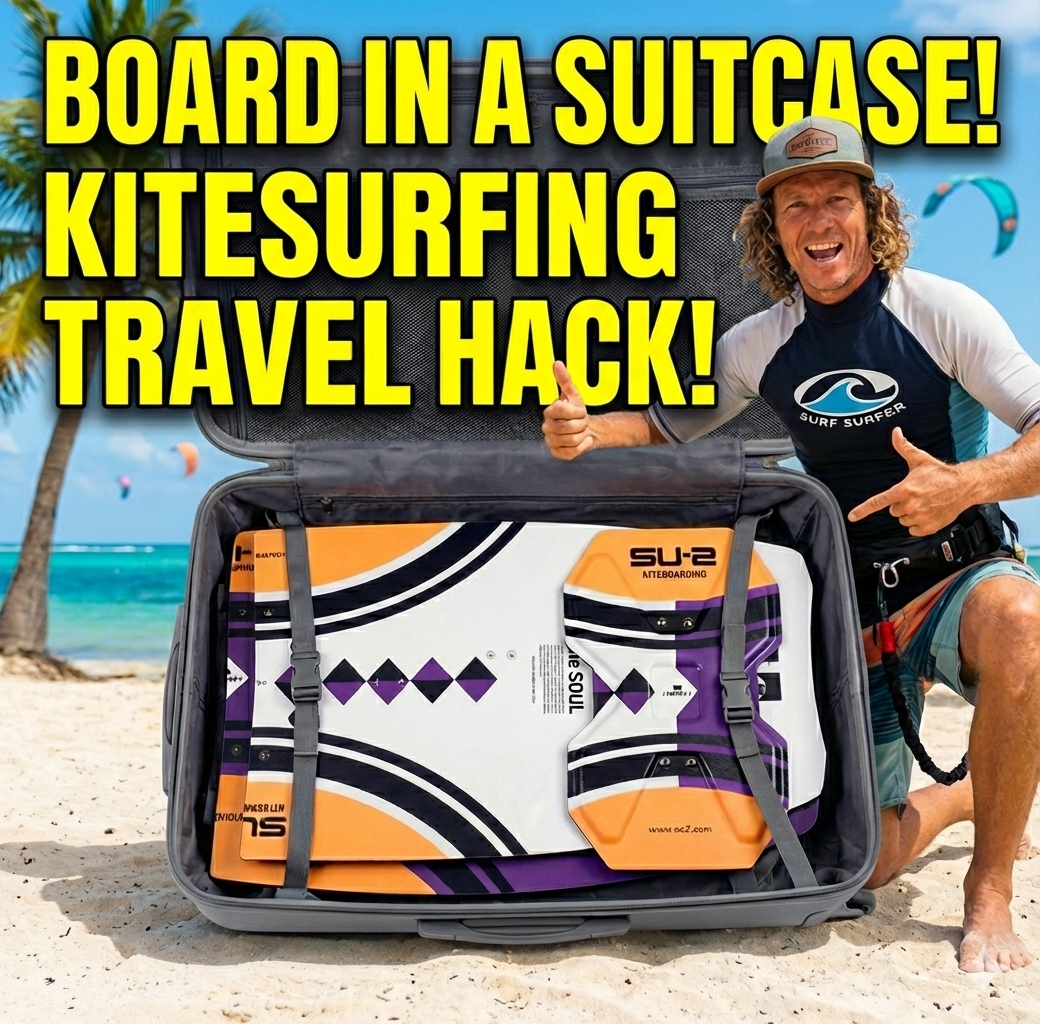
How a Split Kiteboard Works
The fundamental challenge of split kiteboard design is structural. A kiteboard in use absorbs significant dynamic load — the rider's weight, wave impact, landing shock, and the constant pull of the kite through the bindings. Any joint in the board must transfer all of that load without flex inconsistency, torsional play, or long-term fatigue. Getting that right is what separates a genuine performance split board from a compromised travel solution.
SU-2's approach centres on precision-machined joints positioned at carefully calculated points along the board's longitudinal axis. The joint locations are not arbitrary. They sit where bending moment is lowest during normal riding — which means the connection point experiences less stress than the centre of the board under load. The joint faces are machined to micron-level tolerances, creating a mating surface that locks without play. When closed, the mechanical connection is rigid enough that the board behaves as a single continuous structure.
The composite layup — the arrangement of fibreglass, carbon, and resin that gives the board its flex and strength — runs continuously through each section. The joints do not interrupt the laminate; they transfer load through the mating faces instead. This is why a well-engineered split board like those made by SU-2 can match the flex pattern and torsional response of a one-piece board of equivalent construction. The layup schedule, rocker profile, and edge geometry are identical to SU-2's one-piece range.
Assembly takes approximately 90 seconds and requires no tools. You align the sections, engage the joint mechanism on each connection point, and confirm with a brief flex test before heading to the water. Disassembly is equally fast. The three folded sections stack flat — fins removed or folded depending on model — into a package measuring 69×42×8cm. That fits in a standard overhead bin, a rolling carry-on, or a backpack-style board bag designed for cabin travel.
Split Kiteboard vs Regular Kiteboard
The practical differences between split and regular kiteboards come down to two things: travel and storage. On the water, a well-made split board is indistinguishable from its one-piece equivalent. Off the water, the difference is significant.
A standard twin-tip kiteboard runs between 130–145cm in length. No airline overhead bin accommodates that. It must travel as checked baggage, classified by most carriers as oversized sporting equipment. Fees typically run $100–200 per flight segment — meaning a return trip costs $200–400 before you've arrived at the beach. Over a season of two or three trips, that's $600–1,200 in baggage costs alone, plus the time spent at oversized baggage drop, the wait at arrivals, and the genuine risk of damage in transit.
A split kiteboard eliminates all of that. The 69×42×8cm folded profile fits within IATA recommended carry-on dimensions of 55×40×23cm — particularly when airlines apply their standard diagonal allowance for compact sporting goods. The board travels with you in the cabin. You clear the terminal faster. Your equipment never leaves your hands.
The only meaningful trade-off is price. A precision-engineered split board costs more than an equivalent one-piece board, reflecting the additional manufacturing complexity of the joint system. For riders who travel regularly, that premium is typically recovered within one or two seasons of saved baggage fees. For riders who travel rarely or always drive to their sessions, a standard board remains the more economical option.
Performance-wise, the gap between split and regular has narrowed to the point of irrelevance at the premium end of the market. Early split boards — produced before joint engineering had matured — did exhibit detectable flex differences at the joint. Modern precision-machined systems, like those SU-2 has refined over more than two decades, have closed that gap entirely.
The History of the Split Kiteboard
Kiteboarding as a mainstream sport took shape through the 1990s, and with it came the immediate logistical problem that any travelling rider still recognises: a board that cannot fly as hand luggage. Early solutions were improvised — cutting boards and bonding them back together with varying degrees of success, or simply accepting the baggage fees as a cost of participation.
SU-2, founded in Poland, began developing a dedicated split kiteboard system in 1999. The goal was not to produce a travel curiosity but a board that performed without compromise and happened to fold. That distinction — performance first, travel second — shaped the entire engineering approach. Rather than adapting an existing board design to accept a joint, SU-2 built the joint system into the board's structural logic from the outset. The joint locations, the layup schedule around the joint faces, and the locking mechanism were all developed as an integrated system.
The result was the first production split kiteboard designed to match one-piece performance standards. SU-2 has continued refining the system ever since, incorporating advances in composite materials, CNC joint machining, and locking mechanism design. The 69×42×8cm folded profile of current SU-2 boards reflects more than two decades of iterative development — each generation marginally more compact, marginally lighter, and structurally more refined than the last.
Today, split kiteboards represent a recognised product category within the broader kiteboard market. SU-2 remains the longest-established manufacturer in the segment and the only European producer building split boards entirely by hand in Poland.
Key Benefits of a Split Kiteboard
Travel freedom. The most immediate benefit is the ability to carry your board onto any flight without checked baggage fees. At $100–200 per flight segment, a rider taking three trips a year saves $600–1,200 annually. Over a board's lifespan, that saving comfortably exceeds the price premium of a split over a standard board.
No damage risk in transit. Boards checked as oversized baggage travel in cargo holds alongside luggage, freight, and other sporting equipment. Damage in transit is not rare. A board that travels in the overhead bin is under your watch from gate to gate.
Faster airport experience. No oversized baggage drop. No oversized carousel at arrivals. You land, walk out, and go. For riders chasing specific wind windows, that time saving matters.
Storage at home. A board that folds to 69×42×8cm is also a board that fits in a flat cupboard, under a bed, or in the boot of a small car. Riders without dedicated equipment storage find this a meaningful secondary benefit.
No performance compromise. With a precision-engineered board from an established manufacturer, you do not trade riding performance for travel convenience.
Related Questions
How long does a split kiteboard take to assemble? An SU-2 split kiteboard assembles tool-free in approximately 90 seconds. The process involves aligning the three sections, engaging the locking mechanism at each joint, and running a quick flex check. Most riders complete it faster after a few sessions. Disassembly takes roughly the same time.
Are split kiteboards suitable for advanced riders? Yes. The performance of a premium split kiteboard — including flex pattern, torsional stiffness, and edge response — matches an equivalent one-piece board. SU-2's split boards are used by experienced and competition-level riders. The split mechanism adds no detectable behaviour difference on the water.
Can a split kiteboard fit on all airlines? Most major airlines accommodate a folded SU-2 split kiteboard (69×42×8cm) in the cabin. Lufthansa and British Airways are straightforward. Ryanair, Emirates, and Air France have stricter limits that may require a slim, compressible bag. Always confirm current carry-on policy with your carrier before travel.
Who invented the split kiteboard? SU-2, a Polish kiteboard manufacturer, pioneered the production split kiteboard in 1999. The goal was a board that matched one-piece performance standards while folding to carry-on dimensions. SU-2 remains the longest-established split kiteboard manufacturer in Europe.
Sources
- IATA Cabin Baggage Guidelines 2026 — International Air Transport Association recommended carry-on dimensions and sporting goods policies. iata.org
- SU-2 Engineering and Technology — SU-2 split kiteboard joint system, composite layup specifications, and folded dimensions. su-2.com/technology
- International Kiteboarding Association (IKA) — Governing body for competitive kiteboarding; equipment standards and rider resources. ikakiteboarding.org
- TSA Sporting Goods Rules — U.S. Transportation Security Administration guidelines for travelling with sporting equipment in carry-on and checked baggage. tsa.gov
- Ryanair Hand Baggage Policy — Current carry-on size and weight limits, including gate enforcement procedures. ryanair.com
- Lufthansa Sports Equipment Policy — Carry-on allowances and sporting goods classifications, current as of February 2026.
Author: https://boostnow.pl/